Why the Wǔ Symbol is so Important to Anyone Practicing Chinese Martial Arts
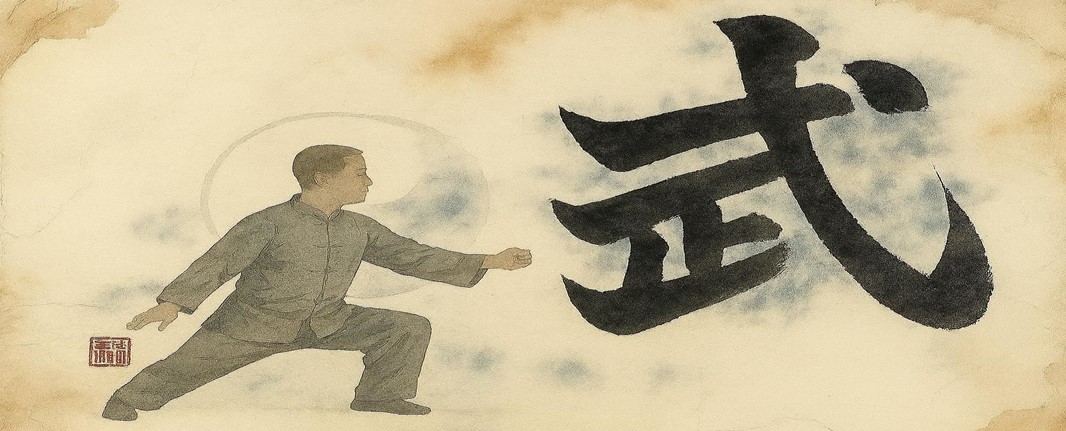
The Wǔ (武) symbol sits at the heart of Chinese martial arts (Wǔshù), and its significance runs far deeper than its direct translation of “martial” or “military.” The character embraces the philosophy that underpins all that is important to our arts and our lives.
The Meaning Encoded in the Character 武 (Wǔ)
At first glance, 武 is often translated as “martial,” but the character is a fusion of two ancient components:
•止 (zhǐ) — to stop, halt, or bring something to a standstill
•戈 (gē) — a spear or long weapon, representing weaponry or conflict
Together, they form a concept closer to “to stop the spear” or “to end violence.” This is the philosophical root of Chinese Martial Arts. The highest skill is not domination or annihilation but the ability to prevent harm, restore balance, and maintain harmony.
This interpretation appears in classical texts, including Confucian writings, where 武 (Wǔ) is associated with restraining violence through virtue and discipline, not aggression.
Why the Wǔ Symbol Matters in Chinese Martial Arts:
1.A Philosophy of Restraint, not Aggression
Chinese martial arts evolved within a cultural framework that values harmony (和), balance (平), and moral conduct (德). The character 武 (Wǔ) reinforces that martial skill is meant to protect, stabilize, and preserve life, not to initiate conflict. This is why many traditional schools teach ethics, meditation, and self-cultivation alongside physical technique.
2.A Guide for Practitioners
For students, 武 (Wǔ) becomes a compass:
•Train to control yourself before controlling others
•Develop strength (and in the internal martial arts, grounding, calm and internal power) to prevent harm, not cause it
•Cultivate awareness, humility, and responsibility
In Taijiquan, for example, softness overcomes hardness, and yielding neutralizes force—perfect expressions of “stopping the spear.”
3.A Bridge Between Martial and Cultural Identity
The symbol appears on school banners, uniforms, temple plaques, and lineage documents. It signals not just a fighting system but a cultural inheritance that blends:
•Daoist ideas of natural balance
•Confucian ethics
•Buddhist compassion
•Military strategy and discipline
To display 武 (Wǔ) is to align oneself with a tradition that values inner cultivation as much as external skill.
4.A Reminder of the Duality within Martial Practice
武 (Wǔ) embodies a paradox: strength and gentleness, action and stillness, force and restraint. This duality mirrors the Yin–Yang dynamic at the core of not only the Chinese Martial Arts, but the overarching focus on balance in all things. A martial artist must be capable of decisive action, yet be guided by clarity and compassion.
How the Symbol Shapes Modern Practice
Even today, 武 (Wǔ) influences how the martial arts are taught and understood:
•In Wǔshù, it represents cultural heritage and artistic expression.
•In traditional schools, it anchors training in moral discipline.
•In Internal Arts, it emphasizes harmony, sensitivity, and redirecting.
•In self defense, it reframes technique as protection rather than aggression.
For many practitioners, 武 (Wǔ) becomes a personal reminder: true power is measured by what you can prevent, not what you can destroy.
A Deeper Layer: 武 (Wǔ) as a Lifelong Cultivation
The character of Wǔ also points to the idea that the Chinese martial arts are a path of continuous refinement. To “stop the spear” is not a single act but an ongoing practice of:
•regulating one’s emotions
•refining perception
•cultivating patience
•strengthening body and mind
•acting with integrity
Ultimately, the significance of 武 (Wǔ) lies in its question. It asks each practitioner to cultivate themselves—not only their bodies, but their character. To refine their emotions, sharpen their perception, and soften their reactions. To become someone who can stand in the midst of conflict and bring stillness, not escalation.
In this sense, 武 (Wǔ) is not a symbol of fighting. It is a symbol of ending the need to fight. A symbol of inner mastery, lived moment by moment.
Perhaps the world would benefit if everyone had a 武 (Wǔ) symbol to reflect on before they went out into the world.
Recent Posts
- Stillness in Movement, Movement in Stillness: The Unity of Yin and Yang in Taijiquan
- Depth Over Dozens: Rethinking Progress in Tai Chi and Qigong
- Could Tai Chi be the Best Thing You Ever do for Your Balance?
- Why We Teach Ba Duan Jin Health Qigong
- Why the Wǔ Symbol is so Important to Anyone Practicing Chinese Martial Arts
- The Year of the Fire Horse – Ride it without Fear
- Caring for the Self
- Eight Energies, Five Steps, Two Weeks, and a Lifetime of Practice: Training at Beijing Sports University 2025
- Qigong: A Guide to Understanding the Many Paths of Energy Cultivation
- The Year of the Wood Snake and Tai Chi/Qigong: A Harmonious Interplay
Tags
Archive
- September 2026 (1)
- August 2026 (1)
- June 2026 (1)
- March 2026 (1)
- February 2026 (1)
- January 2026 (1)
- December 2025 (1)
- November 2025 (1)
- March 2025 (1)
- January 2025 (1)
- November 2024 (1)
- September 2024 (1)
- July 2024 (1)
- January 2024 (2)
- December 2023 (1)
- September 2023 (1)
- June 2023 (2)
- April 2023 (1)
- January 2023 (2)
- November 2022 (1)
- August 2022 (1)
- March 2022 (1)
- January 2022 (2)
- September 2021 (1)
- May 2021 (1)
- March 2021 (1)
- February 2021 (2)
- January 2021 (1)
- December 2020 (1)
- August 2020 (1)
- April 2020 (1)
- January 2020 (1)
- October 2019 (1)
- May 2019 (2)
- April 2019 (1)
- March 2019 (3)
- February 2019 (2)
- January 2019 (3)
- December 2018 (2)
- October 2018 (1)
- July 2018 (1)
- June 2018 (1)
- April 2018 (2)
- February 2018 (1)
- October 2017 (1)
- September 2017 (1)
- April 2017 (2)
- March 2017 (1)
- January 2017 (2)
- December 2016 (2)
- October 2016 (1)
- September 2016 (1)
- August 2016 (1)
- July 2016 (2)
- June 2016 (21)